Governance of Uncertainty
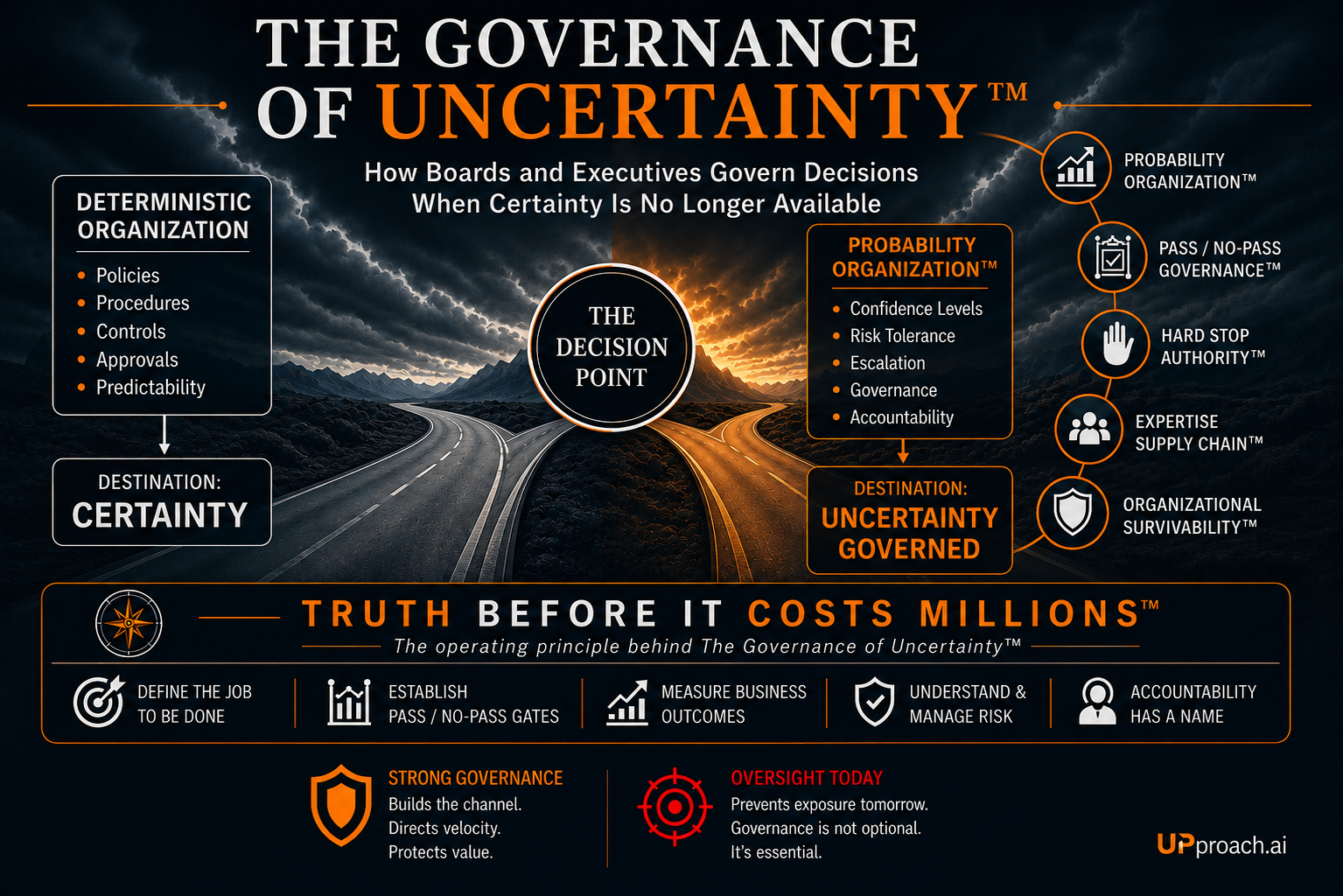
The Governance of Uncertainty™
Truth Before It Costs Millions™
How Boards and Executives Govern Decisions When Certainty Is No Longer Available
For decades, organizations were designed around certainty.
Policies assumed repeatability.
Procedures assumed consistency.
Approvals assumed sufficient information was available to make the correct decision.
Controls assumed risks were known and could be mitigated.
Most management systems were built on a simple premise:If we gather enough information, certainty eventually appears.
AI challenges that assumption.
Not because AI lacks value.
Because AI introduces probability into organizations that were built for certainty.
The New Reality
- An AI recommendation is not a fact.
- It is a probability.
- A forecast is a probability.
- A risk assessment is a probability.
- A customer prediction is a probability.
- A fraud score is a probability.
- Even the confidence score attached to the recommendation is itself a probability.
Organizations are increasingly making decisions based on probabilities rather than certainties.
Yet most governance structures have not changed.
Many organizations still ask:
“Was the process followed?”
When they should also be asking:
“How much uncertainty existed when the decision was made?”
Governance Begins Where Certainty Ends
When outcomes are certain, governance is relatively straightforward.
Rules can be followed.
Thresholds can be defined.
Authority can be delegated.
But uncertainty changes the nature of leadership.
When certainty disappears, executives must answer different questions:
- How much uncertainty is acceptable?
- Who determines that threshold?
- Who owns the consequences?
- Who can stop the decision?
- What happens if the recommendation is wrong?
- How will the organization recover?
These are not technology questions.
They are governance questions.
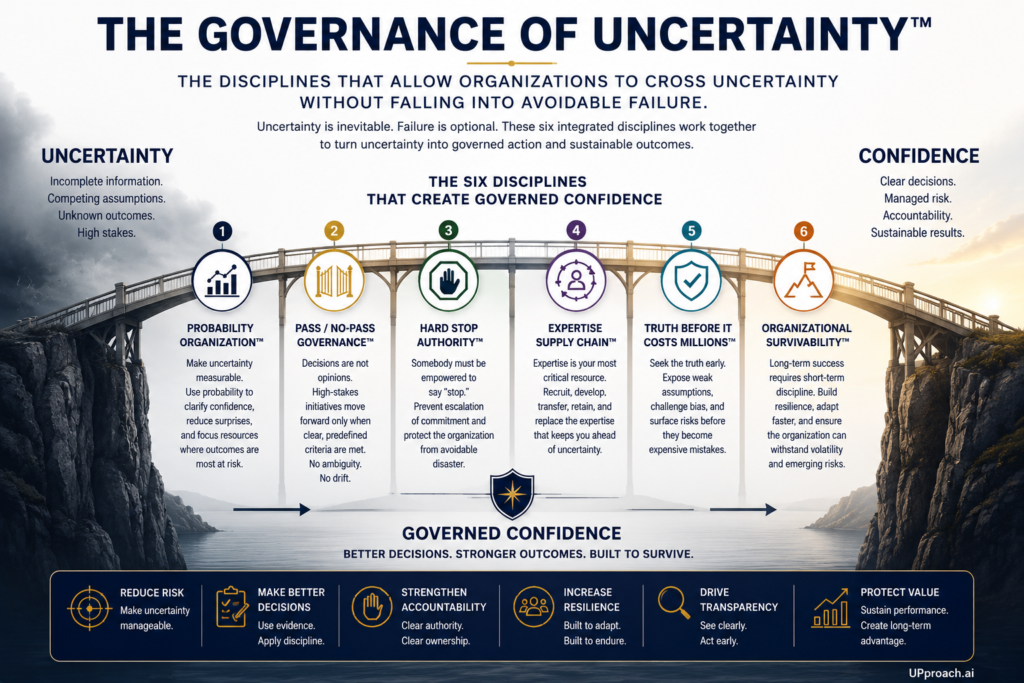
The Probability Organization™
Many organizations are unknowingly becoming a Probability Organization™.
The decision is no longer:
“What is correct?”
The decision becomes:
“What level of confidence is sufficient?”
The difference is significant.
A board may approve a strategic initiative with:
- 95% confidence
- 90% confidence
- 80% confidence
Each threshold represents a different risk profile.
Each threshold represents a different level of uncertainty.
Each threshold represents a different level of accountability.
Yet few organizations formally define where those thresholds should exist.
The Missing Authority Structure
Most organizations have approval authority.
Few have uncertainty authority.
Approval authority answers:
“Who can say yes?”
Uncertainty authority answers:
“Who decides when the probability is acceptable?”
Those are not the same question.
As AI adoption accelerates, organizations increasingly need:
- Confidence thresholds
- Escalation triggers
- Pass / No-Pass gates
- Named accountability
- Hard Stop authority
- Decision reconstruction
Without them, uncertainty becomes unmanaged risk.
The Expertise Problem
The Governance of Uncertainty™ is not solely about technology.
It is also about expertise.
Every organization relies on an Expertise Supply Chain™:/p
- Experts develop.
- Knowledge accumulates.
- Judgment matures.
- Decisions improve.
When expertise disappears, uncertainty increases.
Organizations often discover this too late.
The expert retires.
The exception appears.
The model fails.
Nobody remembers how the decision was made.
At that moment, uncertainty becomes organizational vulnerability.
Organizational Survivability™
The ultimate governance question is not:
“How much AI have we implemented?”
It is:
“Will this organization remain capable, accountable, and resilient because of the decisions we are making today?”
Can the organization still function when:
- The model is wrong?
- The expert has left?
- The exception appears?
- The process behaves unexpectedly?
- The decision cannot be reversed?
Organizations survive uncertainty only when they govern it.
The Future Of Governance
AI did not create uncertainty.
It simply exposed how much uncertainty already existed.
The organizations that thrive will not be those that eliminate uncertainty.
That is impossible.
They will be the organizations that learn to govern it.
They will define acceptable uncertainty.
They will establish decision authority.
They will preserve expertise.
They will maintain accountability.
And they will ensure that someone always retains the authority to stop the process.
Because the future will not belong to the organizations that achieve certainty.
It will belong to the organizations that govern uncertainty better than everyone else.