




Organizations were built for certainty.
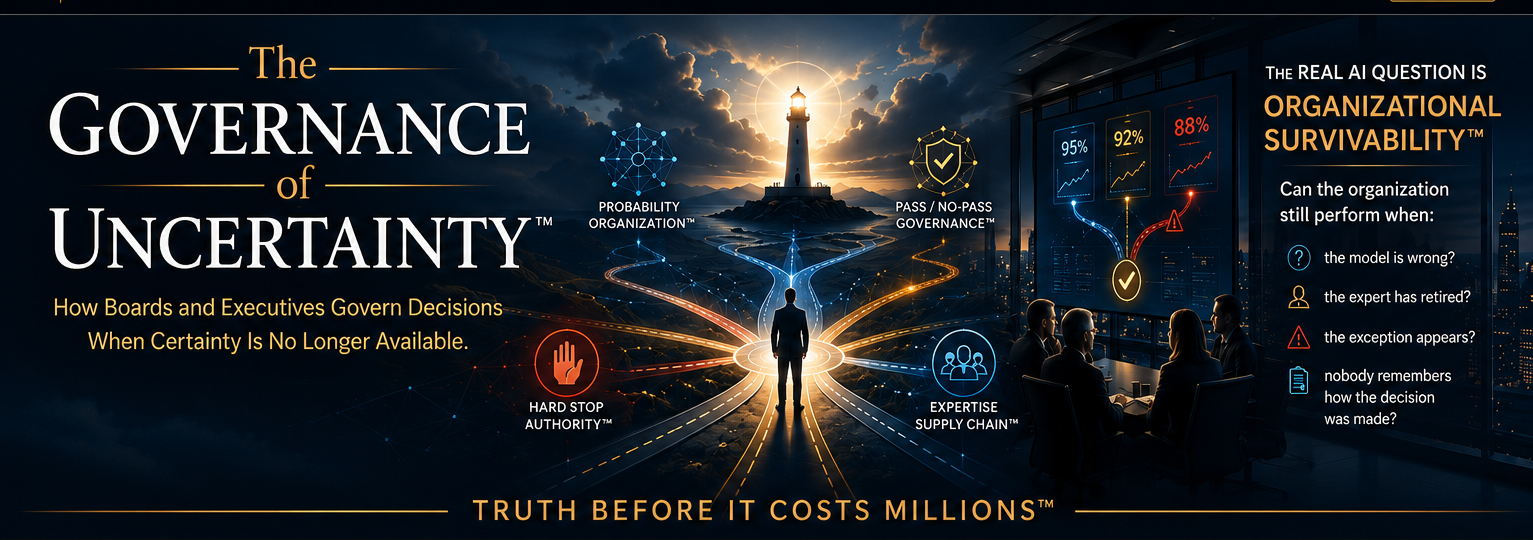
The Governance of Uncertainty™ addresses questions such as:
- How much uncertainty is acceptable?
- Who owns the authority to make probabilistic decisions?
- Who can stop a process when risk becomes unacceptable?
- What happens when the model is wrong?
- Where does expertise reside?
- Can critical decisions be reconstructed and defended?
- Can the organization still perform when expected conditions no longer exist?
The challenge is not eliminating uncertainty. The challenge is governing it.
Organizations that learn to govern uncertainty effectively will continue to make sound decisions even
when outcomes cannot be known in advance. Those that do not may discover that traditional controls
are insufficient when probability replaces certainty.
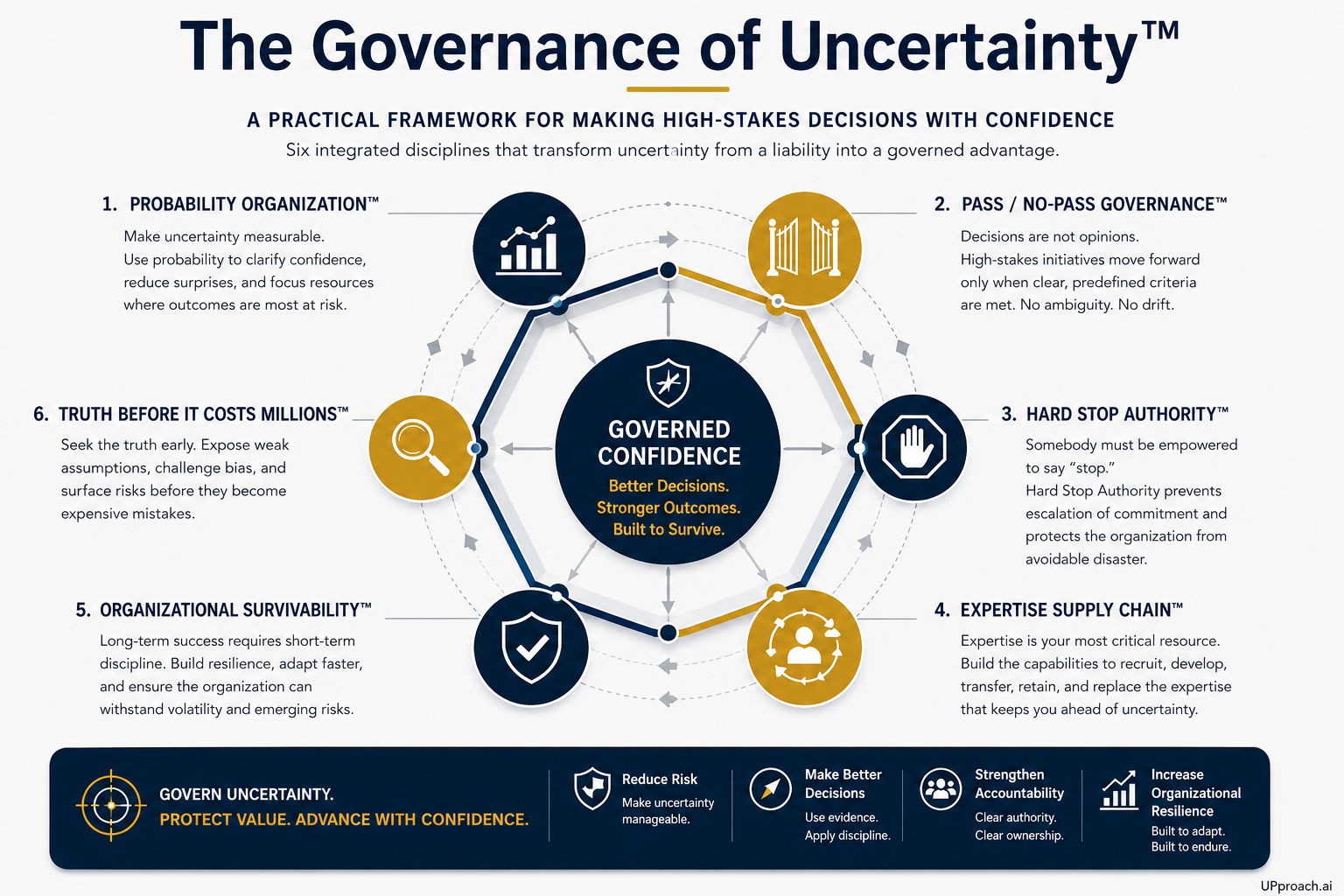
The Core Governance Domains
Why Traditional Governance Is No Longer Enough
Traditional governance was designed to manage known risks.
Financial controls manage financial risk. Compliance programs manage regulatory risk.
Operational procedures manage process risk. Quality systems manage defects and variation.
These approaches remain important, but they share a common assumption:
the risks can be identified, measured, and controlled before decisions are made.
Increasingly, organizations face situations where that assumption no longer holds.
AI systems produce probabilistic recommendations rather than guaranteed answers.
Market conditions change faster than governance cycles. Critical expertise may reside
with a handful of individuals, vendors, or undocumented assumptions. Decisions may become
irreversible long before formal review processes can react.
In these environments, governance cannot rely solely on policies, approvals, and controls.
Governance Must Become an Organizational Capability
When decisions move faster and outcomes become less certain, governance depends on the
organization’s ability to recognize change and respond while action can still matter.
SCALE™ examines five interdependent organizational capabilities:
- Signal — What changed?
- Connection — Who can interpret what it means?
- Awareness — Who else must recognize the possibility?
- Learning — What must the organization reconsider?
- Execute — What judgment, authority, and action are required?
SCALE™ does not replace a governance framework. It tests whether
frameworks, architectures, agents, models, and processes
enable the organization to recognize change and act before the decision window closes.
Organizations must also address:
- Uncertainty thresholds
- Decision authority under ambiguity
- Escalation triggers
- Hard Stop authority
- Expertise continuity
- Decision reconstruction
- Irreversible consequences
- Organizational survivability
The question is no longer whether uncertainty exists…
It does.
The question is whether the organization has developed the structures, authorities,
and capabilities necessary to govern effectively when certainty is unavailable.
Controls mitigate known risks.
The Governance of Uncertainty™ exists because unknown uncertainties remain.
The organizations that thrive in the years ahead
will not be those that eliminate uncertainty.
will not be those that eliminate uncertainty.
The successful organizations will be those that learn how to govern it.