Truth Before It Costs MillionsTM
The Concept
AI Governance IS Irreversible, if It’s an Afterthought!
Boards and executives must tip the AI scale in their favor.
In every process there is a point where it becomes Irreversible that’s the place for a Hard Stop, the discussion, and the go/no go decision from THE BOARD.
The moment before AI scales the failures into material consequences.
Some Decisions Cannot Be Undone
Most organizations focus on making better decisions.
However, few focus on identifying which decisions become irreversible once executed.
That distinction matters!
- A delayed project can be restarted.
- A failed pilot can be redesigned.
- A budget can be revised.
But some decisions permanently change the organization’s risk, capability, reputation, or future options.
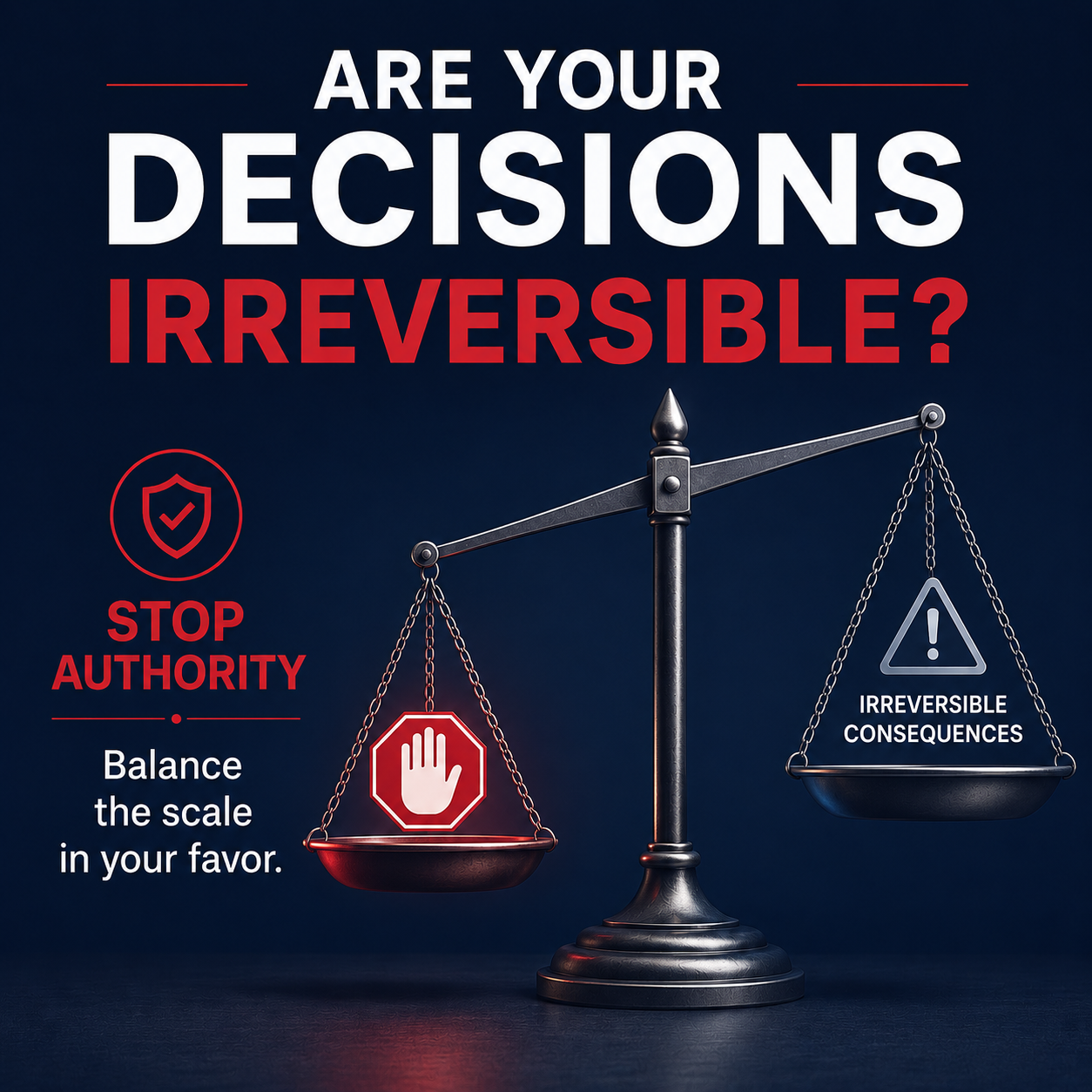
Once crossed, the organization cannot simply return to where it was before.
These are Irreversible Decisions™**
.The Hidden Governance Question
Most governance frameworks ask:
- Was the process followed?
- Was approval obtained?
- Was the decision documented?
The more important question is:
Can this decision be reversed if we discover we were wrong?
If the answer is no, the decision deserves a higher level of scrutiny.
The closer an organization moves toward irreversibility, the greater the need for:
- Executive oversight
- Defined decision authority
- Independent challenge
- Hard Stop Authority™
- Pass / No-Pass Governance™
- Decision reconstruction
Governance becomes most important at the point where mistakes can no longer be easily corrected.
Examples of Irreversible Decisions
Strategic Acquisitions
A failed acquisition may consume years of management attention, destroy shareholder value, and permanently alter organizational direction.
Workforce Elimination
Reducing entry-level positions may improve short-term efficiency.
It may also damage the organization’s future **Expertise Supply Chain™**, creating capability shortages years later.
AI-Driven Automation
Replacing human judgment with automated decision-making can create dependencies that become difficult or impossible to unwind once expertise, processes, and institutional knowledge disappear.
Public Commitments
Product launches, public announcements, regulatory filings, and investor communications can create consequences that cannot be recalled once released.
Safety-Critical Decisions
In aviation, healthcare, manufacturing, and infrastructure, certain decisions carry consequences that cannot be corrected after execution.
The AI Challenge
- Artificial Intelligence introduces a new category of irreversible exposure.
- AI compresses time.
- Organizations often discover mistakes after decisions have already been executed at scale.
- The challenge is not simply whether the model is right.
The challenge is whether the organization can intervene before an incorrect decision becomes irreversible.
Key questions include:
- What is the probability the recommendation is wrong?
- Who owns the consequences?
- What confidence threshold is acceptable?
- Who has authority to stop the process?
- What escalation path exists when uncertainty increases?
- How will the decision be reconstructed and defended later?
Most organizations define approval authority.
Few define uncertainty authority.
The Governance Boundary
The real governance boundary is not the approval meeting.
The real governance boundary is the moment immediately before an irreversible decision is executed.
That is where:
- Pass / No-Pass Governance™ matters.
- Hard Stop Authority™ matters.
- The Governance of Uncertainty™ matters.
Because once execution occurs, governance often becomes documentation of what happened rather than prevention of what could have happened.
Questions Every Board Should Ask… Before approving any significant initiative:
- What makes this decision irreversible?
- What assumptions must remain true for success?
- What happens if those assumptions prove false?
- Who has authority to stop the process?
- At what point does reversal become impossible?
- Can we reconstruct and defend this decision five years from now?
- Will the organization remain capable, accountable, and resilient because of this decision?
Those questions often reveal risks that traditional governance misses.
Truth Before It Costs Millions™
Organizations rarely fail because they lacked information.
They fail because critical questions were not asked before a decision became irreversible.
The purpose of governance is not to document decisions after the fact.
The purpose of governance is to identify irreversible exposure before it becomes irreversible. **Truth Before It Costs Millions™.**