
Because when AI failure becomes visible, organizations must be able to reconstruct how the decision occurred.
Governance is not proven by policies.
Governance is proven by the ability to reconstruct a decision.
AI systems will fail.
Not always dramatically.
Not always immediately.
Many organizations already have failed AI decisions operating in production. The failure has not surfaced.
The real governance question is not whether AI will fail.
The question is whether the organization can reconstruct the decision when the failure becomes visible.
AI systems will fail.
Sometimes the failure is immediate and obvious. More often it remains hidden inside automated workflows, recommendations, and downstream decisions until an outcome raises questions. When that moment occurs, the organization must be able to reconstruct how the decision happened.
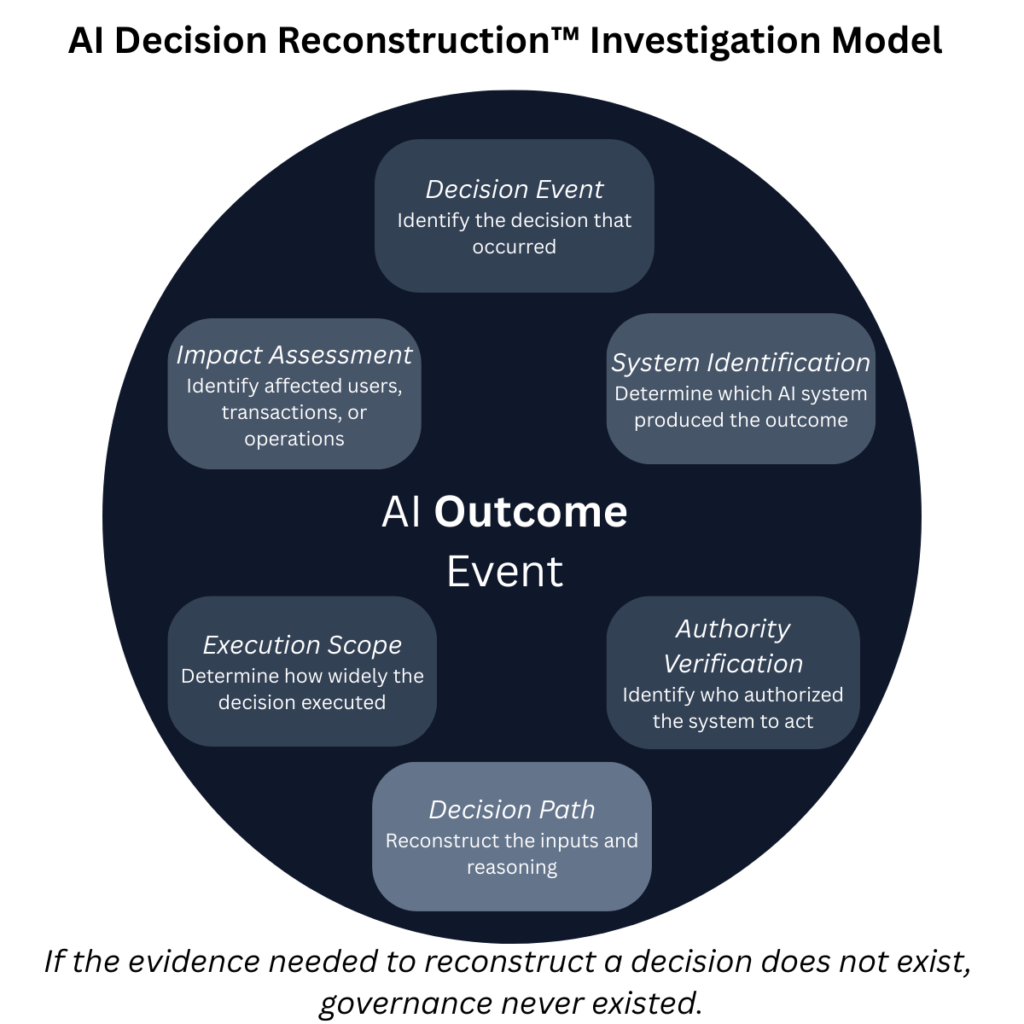
AI Decision Reconstruction™ defines the investigation model for doing exactly that.
Starting with the outcome event, investigators follow the trail of evidence through the decision event, the system that produced it, the authority that allowed it to act, the inputs and reasoning that shaped the outcome, the scope of execution, and ultimately the impact.
If those artifacts do not exist, the decision cannot be explained, responsibility cannot be determined, and the consequences cannot be fully understood.
In that situation, governance did not fail.
Governance never existed.
Many failures remain invisible for long periods of time — buried inside automated workflows, embedded in recommendations, or propagated quietly across systems.
The real governance question is not whether AI will fail.
The question is:
When the failure becomes visible, can the organization reconstruct the decision that caused it?
AI Decision Reconstruction™ addresses that problem.
The Six Investigation Layers of AI Decision Reconstruction™
1. Decision Event
What AI decision occurred?
Every investigation begins with identifying the event itself.
Required evidence artifacts:
- decision output
- timestamp
- triggering input or request
- workflow location where the decision occurred
If this artifact does not exist, investigators cannot define the event.
2. System Identification
Which AI system produced the decision?
Organizations must be able to identify the exact system responsible.
Required evidence artifacts
- model or agent identity
- version or configuration
- vendor or internal system
- integration point within the workflow
Without this evidence, responsibility cannot be established.
3. Authority Verification
Who authorized this system to act?
AI systems should not operate without defined ownership and authority boundaries.
Required evidence artifacts:
- system owner
- deployment approval
- operational authority boundaries
- escalation or override rules
Without this evidence, accountability disappears.
4. Decision Path
How did the system arrive at the outcome?
Investigators must reconstruct the inputs and influences behind the decision.
Required evidence artifacts:
- prompts or inputs
- retrieval sources
- rules or constraints applied
- guardrail or policy checks
Without this evidence, the reasoning behind the outcome cannot be examined.
5. Execution Scope
How widely did the decision execute?
AI decisions often propagate through automation.
Required evidence artifacts:
- execution logs
- frequency of execution
- automation triggers
- downstream systems or workflows triggered
Without this evidence, the scale of the failure cannot be determined.
6. Impact Assessment
Who or what was affected?
The final step is understanding the consequences.
Required evidence artifacts:
- affected customers or users
- affected transactions or decisions
- operational consequences
- financial or regulatory exposure
Without this evidence, the organization cannot fully assess the damage.
If a decision cannot be reconstructed through these layers, governance never existed.
| UPproach™ Structural governance for AI systemsFrameworks Canonical and Doctrine Index AISLC™ Truth Before It Costs Millions™ | Home About Free Tools Advisory Contact | © 2026 UPproach. All rights reserved. Terms Privacy Policy Contact: [email protected] |