Structured board-level assessment of AI exposure and oversight gaps.
Automating a broken process doesn’t fix it. It scales it.
Structured board-level assessment of AI exposure and oversight gaps.
AI rarely fails because of models.
It fails when governance visibility, authority boundaries, and accountability structures are unclear.
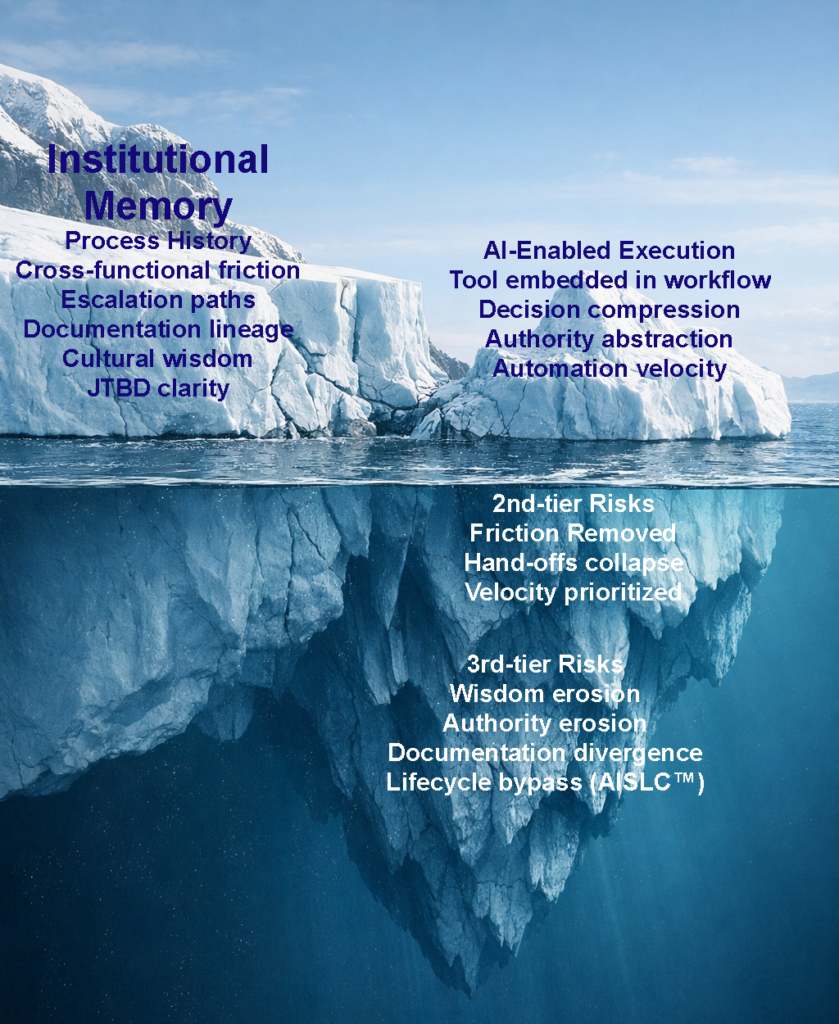
When execution separates from institutional memory, governance loses the ability to guide outcomes and becomes responsible for explaining them.
As AI-enabled execution accelerates, operational systems can begin separating from the institutional memory that historically governed them. Process history, escalation paths, and cultural knowledge remain in the organization, while automated workflows move forward with increasing autonomy.
The further execution drifts from institutional memory, the more governance becomes reactive rather than designed.
The Executive Governance Review examines where AI decisions may already be influencing operations — and whether leadership can clearly identify, explain, and govern those decisions.
Most organizations cannot clearly show where AI is influencing decisions, who holds authority over those decisions, or how those decisions would be reconstructed under scrutiny.
This review focuses on governance visibility and accountability, not model design or technical implementation.
Is your process viable before you automate it?
An Executive Governance Review surfaces process gaps before AI embeds them at scale.