Truth Before It Costs Millions™
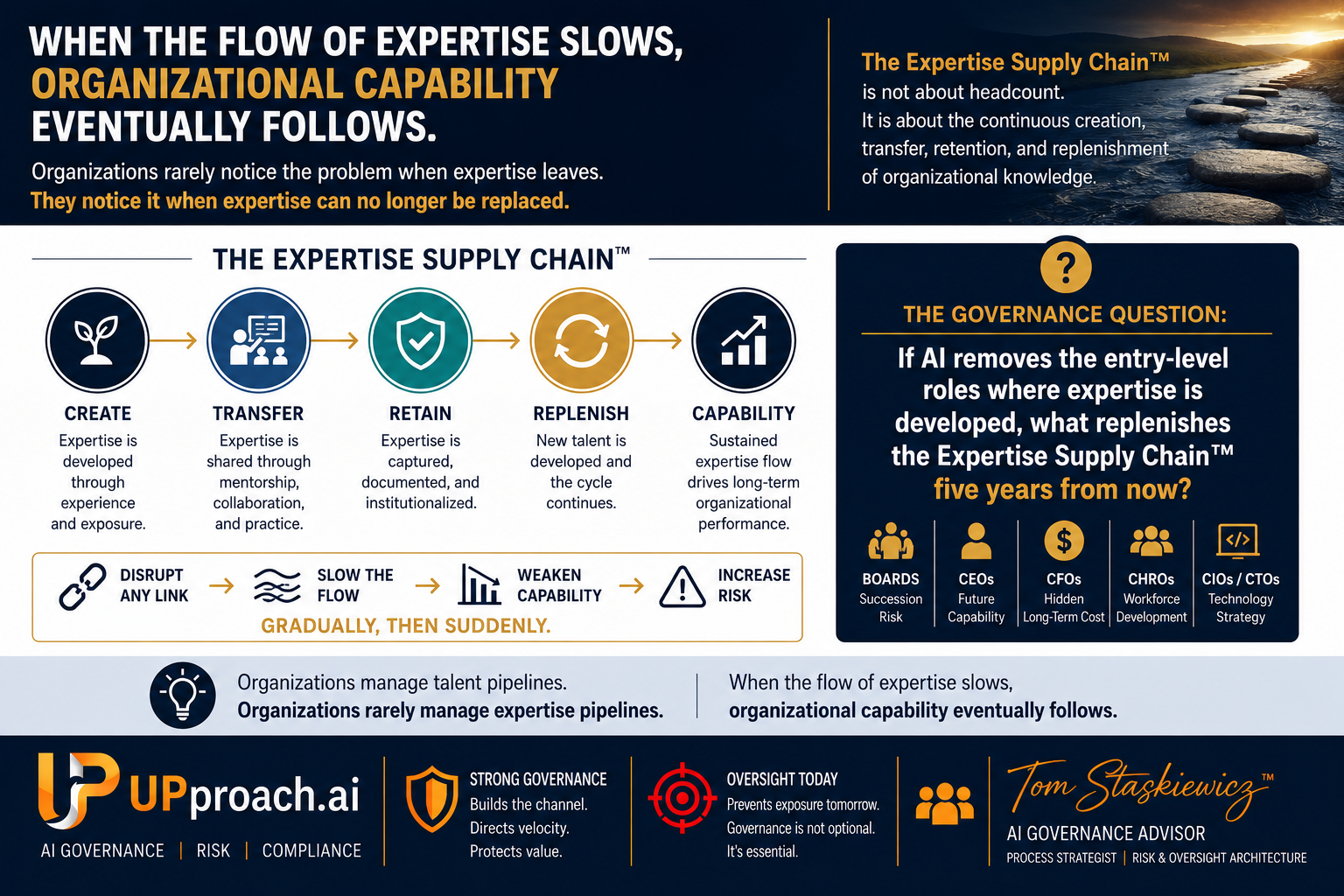
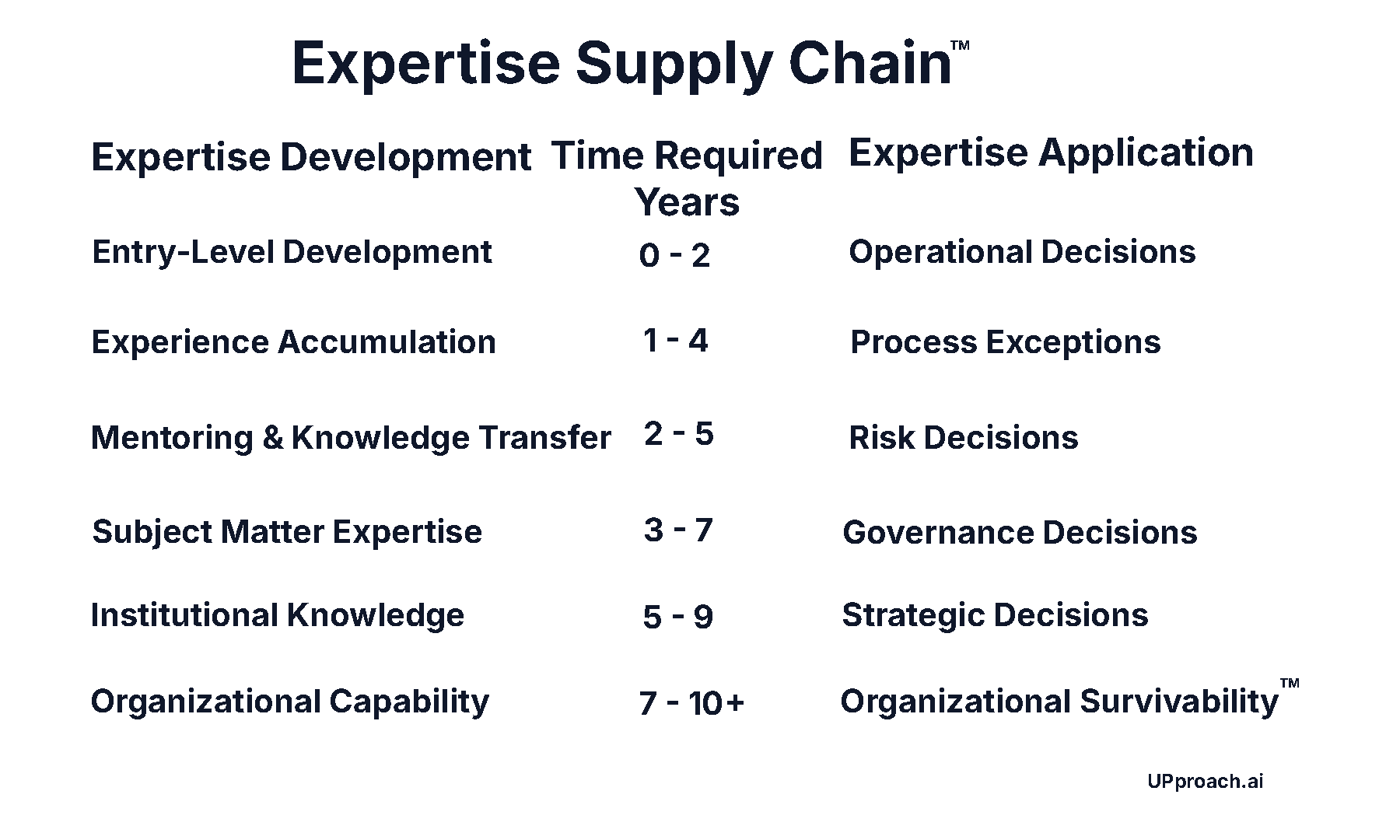
Expertise Supply Chain™
When Expertise Disappears, Risk Does Not
Most organizations understand supply chains for materials, products, vendors, and technology.
Few understand the supply chain for expertise.
Yet expertise is what allows an organization to recognize risk, question assumptions, stop bad decisions, and recover when something goes wrong.
When expertise is lost, retired, outsourced, automated, or never developed, the organization may still appear efficient.
But it becomes less resilient.
What Is The Expertise Supply Chain™?
The Expertise Supply Chain™ is the organizational system that creates, preserves, transfers, and applies critical knowledge.
It includes:
- The people who know how the work is really done
- The experts who recognize exceptions
- The managers who understand consequences
- The reviewers who can challenge assumptions
- The decision-makers who know when to stop
- The next generation being trained to replace today’s experts
AI does not eliminate the need for this chain.
AI makes it more important.
The Risk AI Can Hide
AI often appears to reduce dependency on people.
But in many cases, it removes visibility into the very work that developed expertise in the first place.
- Entry-level work becomes automated.
- Review work becomes summarized.
- Judgment becomes embedded in systems.
- Exceptions become less visible.
- And over time, fewer people understand how decisions are made, why controls exist, or when the system is wrong.
The work did not disappear.
The visibility disappeared.
Why This Matters To Boards And Executives
Boards and executives are responsible for organizational survivability.
That means asking whether the organization can still perform when:
- The model is wrong
- The expert has retired
- The exception appears
- The process breaks
- The decision must be explained
- The customer, regulator, auditor, or court asks what happened
If the organization cannot reconstruct, challenge, or defend the decision, the issue is no longer operational.
It is governance.
The Expertise Supply Chain™ Questions
Every organization should be able to answer:
- Who knows how this process actually works?
- Who understands the exceptions?
- Who can identify when AI output is wrong?
- Who has authority to challenge the recommendation?
- Who is being trained to replace today’s experts?
- What knowledge is being lost through automation?
- What happens when the remaining expert leaves?
- Where does expertise reside: in people, systems, vendors, or assumptions?
AI May Accelerate Wisdom Erosion™
When AI removes tasks from people, it may also remove the learning path that created future experts.
This creates Wisdom Erosion™.
The organization gains short-term efficiency but loses long-term judgment.
That loss may not appear immediately.
It appears later, when something unusual happens and nobody remembers why the old control existed.
Expertise Is A Governance Asset
Expertise is not just a staffing issue.
It is not only a training issue.
It is not just a human resources issue.
Expertise is a governance asset.
Without it, organizations lose the ability to question, intervene, escalate, and recover.
A strong Expertise Supply Chain™ helps ensure the organization remains capable, accountable, and resilient as AI changes how work is performed.
Signs Your Expertise Supply Chain™ Is Weakening
Your organization may be at risk if:
- Critical knowledge is concentrated in one or two people
- Retirements or departures create operational panic
- AI tools are replacing entry-level learning paths
- Reviewers approve outputs they cannot independently evaluate
- Exceptions are handled by systems rather than experienced judgment
- Vendors understand the process better than internal teams
- Nobody can explain why certain controls exist
- Leadership cannot identify who has Hard Stop Authority™
The Governance Question
The question is not simply:
“Can AI do the work?”
The better question is:
“Will the organization still know how the work should be done?”
Because when expertise disappears, accountability does not.
Protecting The Expertise Supply Chain™
Organizations should identify where expertise is created, where it is stored, where it is transferred, and where it is being lost.
This includes:
- Mapping critical knowledge
- Identifying single points of expertise failure
- Preserving institutional judgment
- Maintaining human review capability
- Defining escalation paths
- Protecting entry-level learning pipelines
- Assigning Hard Stop Authority™
- Ensuring decisions can be reconstructed and defended
AI can support the organization.
It should not hollow it out.
Truth Before It Costs Millions™
The Expertise Supply Chain™ exists because organizations do not fail only from bad technology.
They fail when nobody knows enough to recognize the technology is wrong.
Truth Before It Costs Millions™ means identifying that risk before the expert is gone, the process is automated, and the failure becomes material.
Executive Advisory Support
helps executives and boards evaluate whether AI adoption is weakening the organization’s expertise, accountability, and decision authority structures.
If this discussion raises questions about your organization’s AI governance, expertise retention, or survivability, feel free to reach out.